
When Should You Refurbish a Charity Shop — and When Should You Leave It Alone?
Refurbishment should never be the automatic answer to an ageing charity shop.
Nor should strong sales automatically be a reason to leave one alone.
Both approaches risk starting with the building rather than the commercial opportunity.
The more useful question is whether investment in the physical environment could create enough additional value to justify the cost. That value might come through increased sales, greater stock density, better donations, improved volunteer recruitment and retention, lower maintenance costs, more efficient operations or simply enabling a successful shop to fulfil more of its potential.
Sometimes that case is compelling.
Sometimes the most commercially responsible decision is to do very little.
And occasionally, the shop that looks most in need of refurbishment is precisely the one where further investment makes the least sense.
Refurbishment should start with opportunity, not appearance
It is easy to walk into an older charity shop and immediately see what could be changed.
The flooring is tired. The lighting is dated. Fixtures have accumulated over years rather than being deliberately specified. Signage has been added at different times. The brand has evolved while the shop has largely remained the same.
Visually, the argument for refurbishment can seem obvious.
Commercially, it may be anything but.
A refurbishment needs to achieve something.
If £30,000, £50,000 or £100,000 is going to be invested in a store, the conversation should extend beyond how much better the shop could look. What additional value could that investment unlock?
That distinction is particularly important in charity retail, where every pound invested in the estate ultimately needs to be considered against the purpose of the organisation.
Good retail design isn't about spending money to make shops more attractive. It is about using investment intelligently to make the retail operation work harder.
A successful shop may actually present the strongest opportunity
One of the easiest assumptions to make is that refurbishment should be concentrated on poorly performing stores.
But a high-performing shop can sometimes present a far stronger investment case.
Imagine a store that already trades well despite an environment that hasn't been substantially updated for years. It has strong footfall, a healthy donor base, a good local reputation and a team capable of delivering results.
The question shouldn't necessarily be: why change something that's working?
The more interesting consideration is what might be possible if some of the constraints holding that store back were removed.
Perhaps the current fixture layout limits the amount of stock that can be presented effectively. A redesigned system could increase density without making the shop feel overcrowded.
Perhaps donations are strong but the processing environment cannot handle the volume efficiently.
Perhaps the shop attracts customers but the environment doesn't encourage them to explore the whole space.
Perhaps the organisation struggles to recruit volunteers into a shop that feels tired and poorly equipped compared with the other retail environments around it.
Or perhaps the customer profile has evolved while the store hasn't.
In those circumstances, refurbishment isn't about rescuing a failing shop. It is about investing behind an already proven location and asking it to deliver more.
That can be a considerably stronger commercial proposition.
Performance is about more than the till
The impact of a charity shop environment shouldn't be judged solely by sales.
A charity shop has several audiences at once.
There is the customer who comes in to buy. There is the donor arriving with bags of stock. There is the volunteer deciding whether this feels like somewhere they would enjoy giving their time. There is the paid team trying to process, replenish and merchandise a constantly changing product offer.
The physical environment affects all of them.
A better donation journey can make giving easier and more welcoming. Better processing areas can increase the speed at which donated stock reaches the shop floor. More considered fixtures can increase selling capacity. Better sightlines can make more of the floor commercially productive. Improved staff and volunteer spaces can make the working environment more appealing.
This is why the return on refurbishment cannot always be understood simply as new shop versus old shop.
The opportunity sits across the entire operation.
A refurbishment that creates 10% more effective selling capacity, improves stock flow and provides a substantially better donation experience may create value in ways that aren't immediately visible in a photograph of the finished shop.
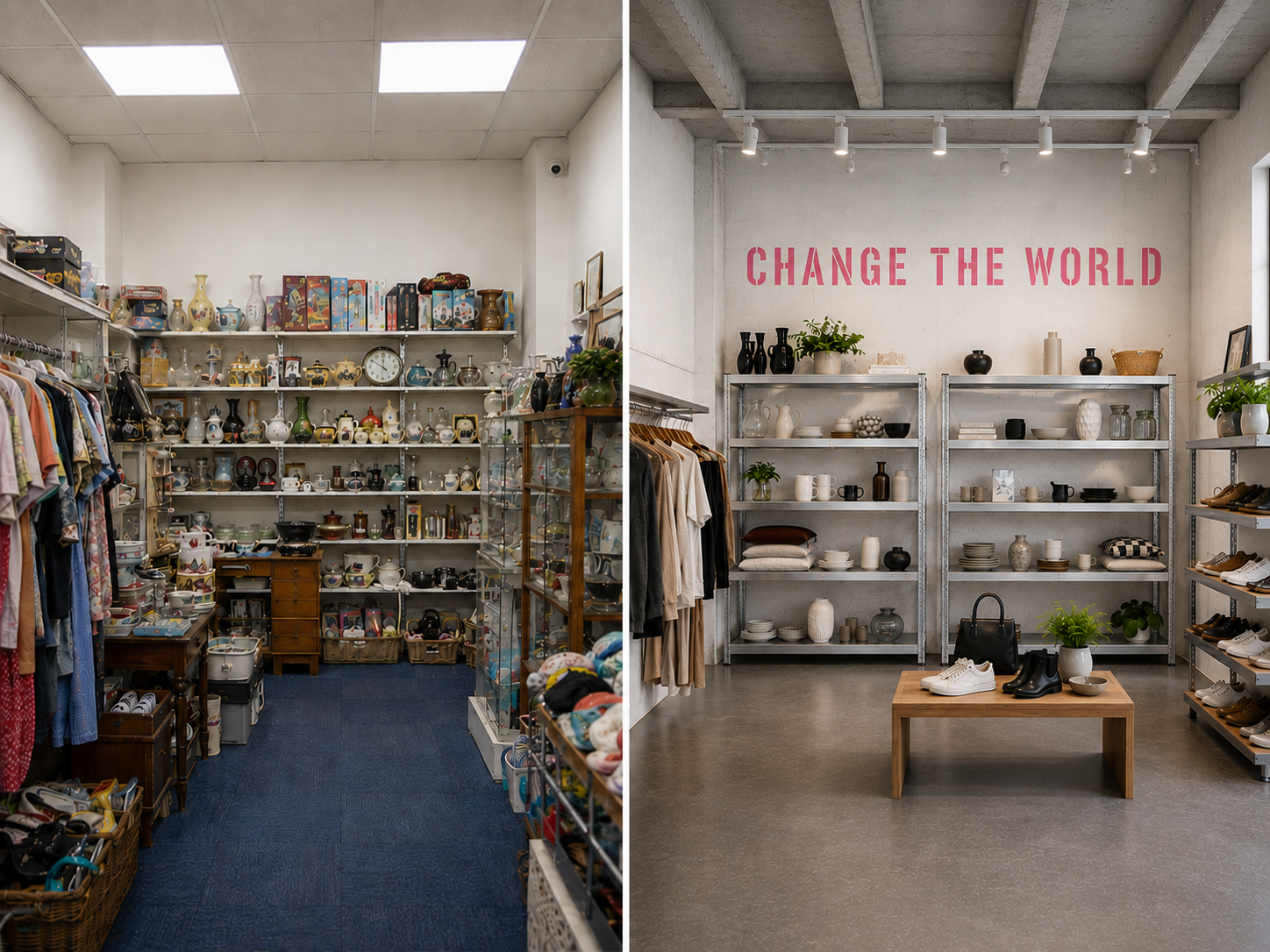
Sometimes the shop has simply been allowed to fall behind
There is also a point at which continued patching becomes its own form of investment.
A light fails and is replaced. A fixture breaks and another is found. One wall is repainted. Another piece of signage is added. Flooring is repaired rather than replaced. Different generations of equipment slowly accumulate.
None of these individual decisions is necessarily wrong.
But over time, a store can become the product of hundreds of small fixes rather than one coherent retail strategy.
This can be particularly noticeable within larger portfolios. A charity may have developed considerably — a new identity, new campaigns, a stronger digital presence and a much clearer understanding of its audience — while some of its physical shops still represent an organisation from ten or fifteen years earlier.
At that point refurbishment can do more than renew finishes.
It can reset the environment.
Layout, fixtures, operational flow, brand communication, donation experience, accessibility, lighting and maintenance can be considered together rather than continuing to solve each problem independently.
That is where refurbishment becomes more valuable than decoration.
But poor performance isn't automatically an argument for investment
This is perhaps where the decision becomes most important.
A poorly performing shop may look like an obvious candidate for refurbishment. New fixtures, better windows and a stronger environment might appear to offer a route back to growth.
But first there has to be confidence that the physical environment is actually part of the problem.
A shop may once have performed exceptionally well and gradually deteriorated because the environment was allowed to decay. Customers remain in the area. Donations remain available. The location is fundamentally sound, but years of underinvestment have reduced its ability to compete.
There may be a very credible case for intervention.
But another shop may be declining because the high street around it has changed. Footfall may have moved. The local customer base may no longer support the offer. Occupancy costs may be too high. The unit may be the wrong size or configuration. Another nearby location may offer substantially better potential.
A beautiful refurbishment cannot correct a fundamentally weak property decision.
Investing heavily simply because a shop is performing poorly risks spending charitable funds on the symptom rather than addressing the cause.
In that situation, leaving the shop alone may not mean accepting poor performance indefinitely.
It may mean making a bigger commercial decision about whether that store should remain part of the portfolio at all.
There is also a large space between “refurbish” and “do nothing”
Not every opportunity requires a full strip-out.
Sometimes the commercial case exists for improvement, but not for wholesale replacement.
A store may have a fundamentally good layout but poor lighting. Existing fixtures may be perfectly serviceable but badly positioned. The brand application may need updating while the physical infrastructure remains sound. A donation area may need redesigning without touching the rest of the shop.
This is where having a defined charity retail concept becomes particularly useful.
A concept shouldn't require every store to be rebuilt from scratch in order to participate in it.
It should establish principles that can be applied at different levels of investment.
The strongest elements can be retained. Existing fixtures can potentially be refinished or repositioned. New components can be introduced where they will have the greatest impact. Brand, signage and tone of voice can create consistency without unnecessary construction.
The result may not technically be a refurbishment at all.
It may simply be a better use of what is already there.
And commercially, that could be exactly the right answer.
Refurbishment should have a reason
Ultimately, deciding whether to refurbish a charity shop is not really a design question.
It is an investment decision.
A successful shop shouldn't be left alone simply because it already performs. If there is credible potential to increase sales, donations, volunteer engagement, stock capacity or operational efficiency, investment may allow an already strong store to become significantly stronger.
Equally, a poor-performing shop shouldn't automatically receive investment because it looks tired. If the underlying location no longer works commercially, refurbishment may simply make an unviable shop look better.
The case becomes strongest when there is a clear opportunity, a physical environment that is preventing that opportunity from being realised and a proportionate level of investment capable of unlocking it.
And the case becomes weakest when the problem lies somewhere that design cannot fix.
Final thoughts
There is no prize for having the newest charity shop estate.
The objective should be to have the most effective estate possible for the resources available.
Some shops may justify substantial investment. Others may need a carefully targeted intervention. Some successful stores may deserve investment precisely because their potential is greater than their current environment allows them to achieve.
And some stores should be left alone because the sensible next decision isn't refurbishment at all — it is a commercial decision about their future.
That is why refurbishment shouldn't begin with:
This shop looks tired.
It should begin with a much more valuable proposition:
We know what this shop could achieve, we understand what is currently preventing it from getting there, and we know how investment in the environment can help close that gap.
That is the point at which refurbishment stops being a cost.
It becomes an investment.
